Gamification
Part of the Anaya Care Handbook — the source of truth for how the product must behave. When the product needs to change, change this document first, then make the system match it.
Implementation status — this module is specified but not yet built. Every rule below is 🚧 Spec only until the feature ships and this page is audited against the code. Legend: ✅ In code · ⚠️ Partial · 🚧 Spec only (not yet built).
What this covers
This page governs : an agency-configurable scheme that recognises and motivates care providers within an agency. Anaya provides the underlying infrastructure; each agency configures and manages the scheme for its own staff. It runs separately for every agency, and a company's configuration and results never touch another company's.
The scheme has two sides. Care-provider gamification awards points, badges, and rewards for work activity, and can feed Performance Evaluation. Elder Gamification (Lite) is a gentle, non-competitive layer that encourages clients to take part in their own activity program and tracks their progress; it is facilitated by a care provider. It sits alongside the platform's other care-provider-engagement features: Daily Motivations, Trainings, and Skills, Ratings & Feature Requests.
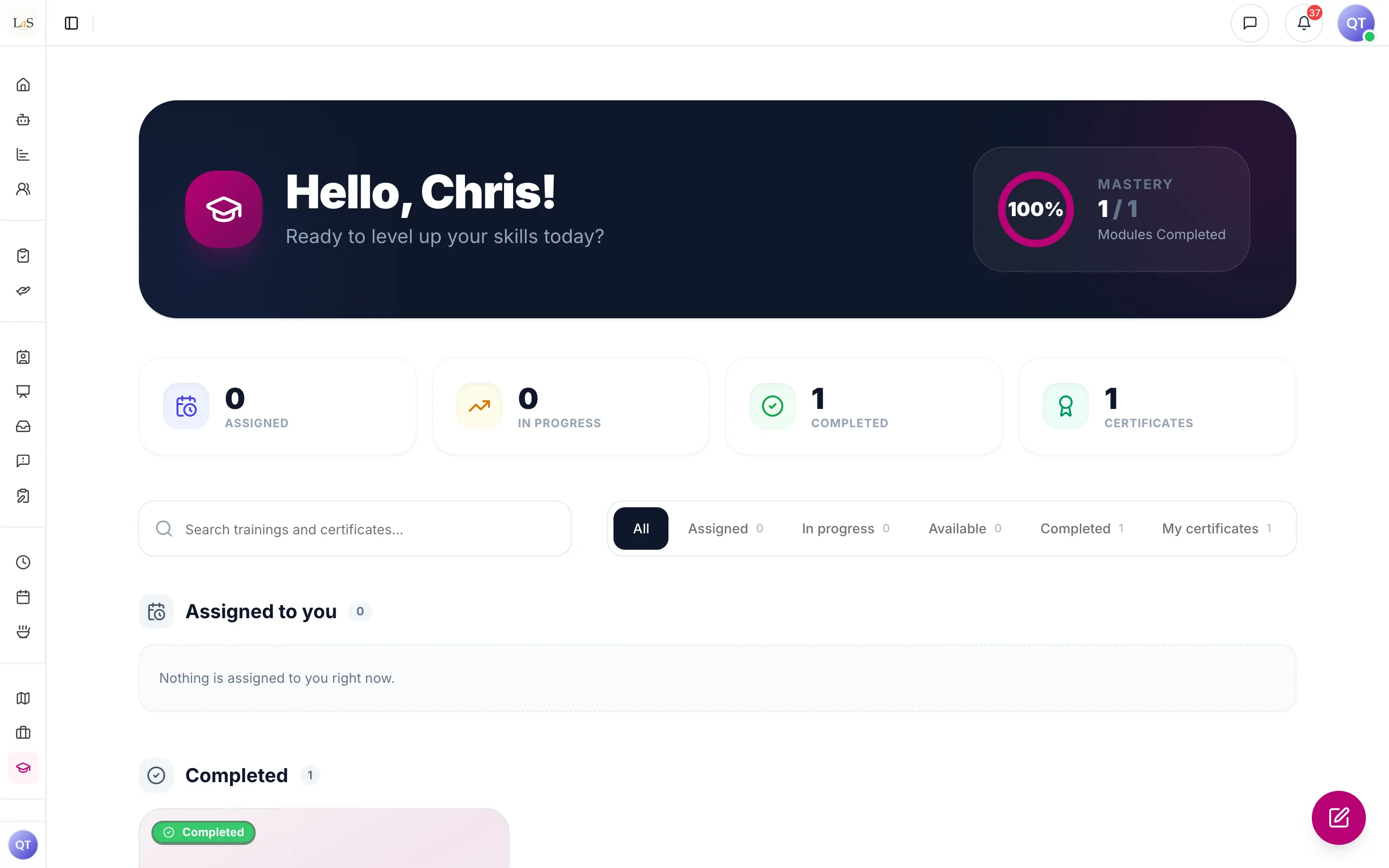
What exists today: nothing awards points, badges or rewards. The nearest thing is the Training Center's count of enrollments and completions.
Key terms
- Gamification scheme — the agency-defined arrangement that recognises care provider activity through points, badges, milestones, leaderboards, challenges, and rewards.
- Configure — defining and switching on the scheme for a company; an Owner/Admin permission.
- Manage — running the scheme day to day within the configured arrangement, including setting challenges; a Care manager permission.
- Standing — a care provider's own position within the scheme — points, badges, and milestones — which the care provider can view.
- Points — units a care provider earns for activity such as completing a shift, finishing the Care Readiness Quiz, completing a training or certification, perfect documentation, on-time clock in and clock out, Care Feed posts, and challenges.
- Badges & milestones — recognitions awarded for performance achievements.
- Leaderboard — an optional, company-specific, filterable ranking display that an agency may choose to switch on.
- Challenge — a time-bound goal a Care manager sets for care providers.
- Reward — a digital or tangible recognition the agency grants for participation or achievement.
- Elder Gamification (Lite) — a gentle, non-competitive layer that encourages a client to take part in their activity program and tracks progress at a level appropriate to the client; facilitated by a care provider.
How it works
Anaya provides the gamification infrastructure; each agency configures and manages the scheme for its own staff. Owners and admins configure the scheme for their company; because Anaya Care is multi-tenant, that configuration applies to one company only and never affects another. Care managers manage the running scheme — including setting challenges — and can view it across the company's care providers. Each care provider can view their own standing. Representatives have no access to gamification at all.
Care-provider gamification
Care providers earn points for work activity: completing a shift, finishing the Care Readiness Quiz (the PRD calls this the "Daily Login Quiz"), completing a training, earning a certification, perfect documentation, clocking in and out on time, posting to the Care Feed, and completing challenges. Points accrue toward badges and milestones that recognise performance achievements.
A Care manager can set challenges — time-bound goals for care providers. An agency may optionally switch on a leaderboard: a company-specific, filterable ranking that displays how care providers compare. Leaderboards are optional, controlled per company, and never span more than one agency. Agencies grant rewards — digital or tangible — for participation and achievement.
Care-provider scores feed Performance Evaluation, so the same activity that earns recognition also contributes to that record. The scheme is motivational only: it must never be used to penalise a care provider.
Elder Gamification (Lite)
A lighter layer encourages clients to take part in their own activity program and tracks their progress. It is non-competitive — encouraging only, never ranked — and is pitched at a level appropriate to the individual client. A care provider facilitates it as part of delivering the client's activities. Representatives and families are not included.
Rules
- GAME-1 — Each subscribing company has its own gamification scheme, configured independently. A company's configuration and standings must never be visible to, or affected by, any other company. (🚧 Spec only)
- GAME-2 — An owner or admin can configure their company's gamification scheme — defining and switching on the arrangement. (🚧 Spec only)
- GAME-3 — A Care manager can manage and view the company's gamification scheme, but cannot configure it. (🚧 Spec only)
- GAME-4 — A care provider can view their own standing in the scheme, and cannot configure or manage it. (🚧 Spec only)
- GAME-5 — Representatives have no access to gamification: they can neither view nor change any part of it. (🚧 Spec only)
- GAME-6 — Care providers earn points for work activity, including completing a shift, finishing the Care Readiness Quiz, completing a training, earning a certification, perfect documentation, on-time clock in and clock out, Care Feed posts, and completing challenges. (🚧 Spec only)
- GAME-7 — Points accrue toward badges and milestones that recognise performance achievements. (🚧 Spec only)
- GAME-8 — A Care manager can set time-bound challenges for care providers. (🚧 Spec only)
- GAME-9 — An agency may optionally switch on a company-specific, filterable leaderboard; when it is off, no ranking is displayed. (🚧 Spec only)
- GAME-10 — An agency can grant digital and tangible rewards for participation and achievement. (🚧 Spec only)
- GAME-11 — Care-provider scores feed the Performance Evaluation record. (🚧 Spec only)
- GAME-12 — Gamification is motivational only and must never be used to penalise a care provider. (🚧 Spec only)
- GAME-13 — Elder Gamification (Lite) encourages a client to take part in their activity program and tracks progress; it is non-competitive, pitched at a level appropriate to the client, and facilitated by a care provider. (🚧 Spec only)
Who can do what
| Action | Owner/Admin | Care manager | Care provider | Representative |
|---|---|---|---|---|
| Configure the gamification scheme | ✅ | — | — | — |
| Manage the scheme | ✅ | ✅ | — | — |
| Set challenges | ✅ | ✅ | — | — |
| Grant rewards | ✅ | ✅ | — | — |
| Earn points, badges & milestones | — | — | ✅ | — |
| View the scheme / own standing | ✅ | ✅ | ✅ (own) | — |
| Facilitate Elder Gamification (Lite) | — | — | ✅ | — |
Decisions needed
- How many points does each activity earn, and can agencies tune the values? lists what earns points but not how many, nor whether the point values are fixed by Anaya or configurable per agency. Options: fixed platform-wide values; agency-configurable weights; a mix (Anaya defaults that agencies may override).
- What counts as "perfect documentation" for ? The criteria for awarding documentation points are not defined — for example, no missing fields, on-time submission, or supervisor sign-off. This needs a concrete definition before build.
- How does feeding Performance Evaluation () coexist with the non-penalisation rule ()? Scores feed the evaluation record, yet gamification must never penalise. The boundary — what is shown as recognition versus what informs assessment — needs to be drawn so the two rules do not conflict.
- What does Elder Gamification (Lite) actually track and reward ()? "Activity encouragement and progress tracking" is named but the specific activities, progress signals, and how the care provider records them are undefined.
How is this page?
Last updated on