Adaptive Technology Integration
Part of the Anaya Care Handbook — the source of truth for how the product must behave. When the product needs to change, change this document first, then make the system match it.
Implementation status — this module is specified but not yet built. Every rule below is 🚧 Spec only until the feature ships and this page is audited against the code. Legend: ✅ In code · ⚠️ Partial · 🚧 Spec only (not yet built).
What this covers
This page governs adaptive technology integration: the future capability that lets Anaya Care work alongside the assistive hardware and smart-home devices a client or care provider already relies on. It covers voice-activated reminders and routines through smart-home assistants (Amazon Alexa, Google Home), switch-access compatibility for people with limited motor function, hearing-aid Bluetooth compatibility, screen-magnification compatibility, and voice-activated navigation inside the app.
This is about making Anaya Care reach beyond the screen and meet people where their existing devices are. It extends the in-app accommodations covered in Accessibility out to third-party hardware, and where it connects to outside platforms it follows the rules in Integrations & API.
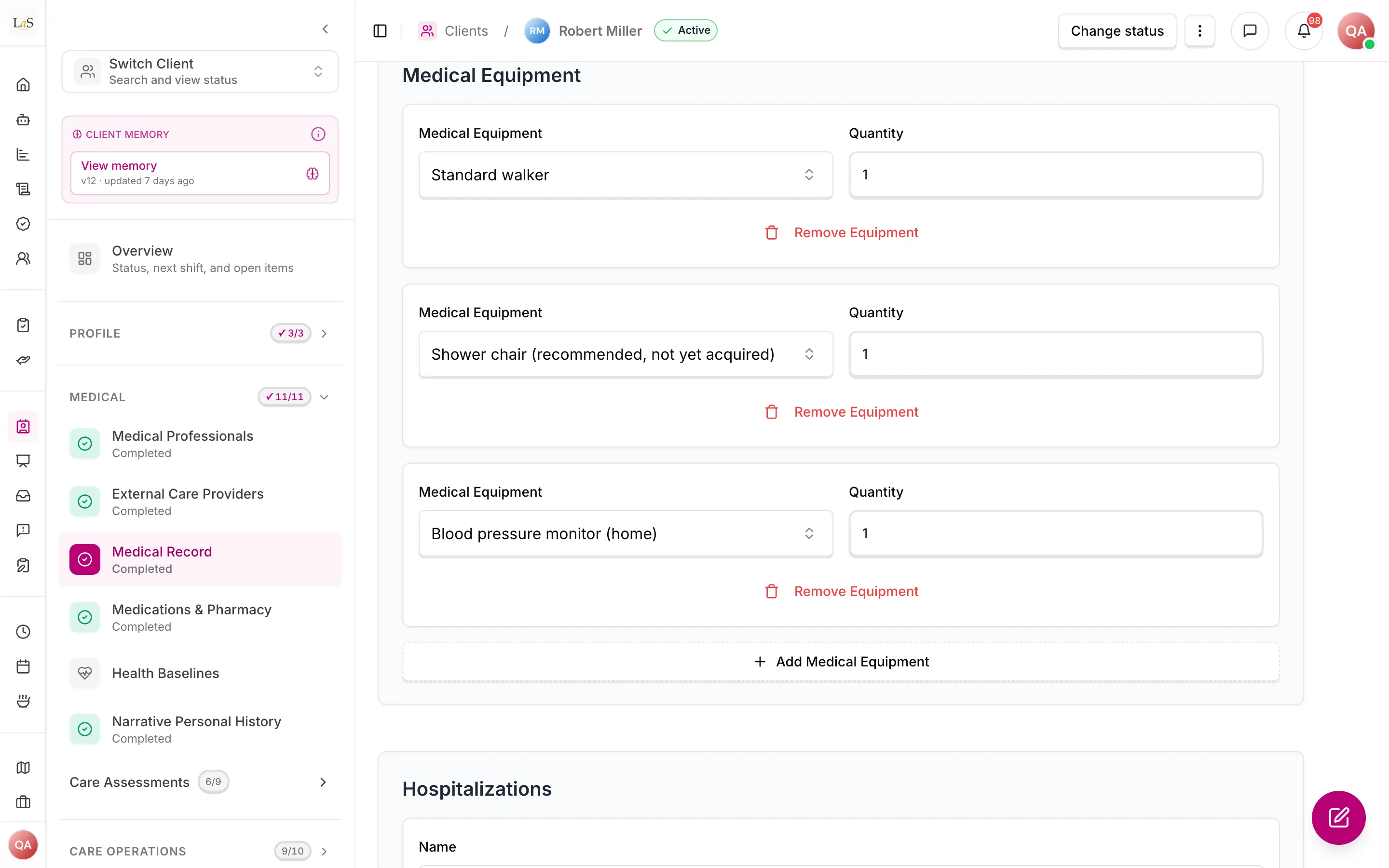
What exists today: a client's assistive equipment is a list on the medical record. Nothing in the product connects to a device.
Key terms
- Adaptive technology — assistive hardware or software a person uses to interact with the world, such as a switch device, a Bluetooth hearing aid, or a screen magnifier, that Anaya Care must work alongside rather than against.
- Smart-home device integration — a connection between Anaya Care and a voice assistant (Amazon Alexa, Google Home) so reminders and routines can be heard and acted on out loud in the home.
- Voice-activated reminder — a reminder, such as a medication reminder, spoken aloud through a connected smart-home assistant instead of, or in addition to, appearing on a screen.
- Switch access — a way of operating the app using one or more adaptive switches (for example a button or sip-and-puff device) instead of touch, for people with limited motor function.
- Hearing-aid Bluetooth compatibility — the app's audio output (alerts, voice prompts, telehealth calls) streaming directly to a paired Bluetooth hearing aid.
- Screen-magnification compatibility — the app remaining fully usable when the operating system's screen magnifier is enlarging part of the screen, with no content cut off or trapped off-screen.
- Voice-activated navigation — moving through the app and triggering actions by speaking commands, rather than tapping.
How it works
Adaptive technology integration is a Future capability: the intended behaviour is described here so the product can be built to it, but none of it is implemented yet.
Smart-home device integration
A client or representative can connect Anaya Care to a supported voice assistant (Amazon Alexa or Google Home). Once connected, reminders and routines configured in the platform — most importantly medication reminders — can be spoken aloud in the home through that assistant. The connection is established through the third-party platform's own linking flow, and the rules in Integrations & API govern how that link is authorised and secured. Smart-home reminders stay reminder-only: the assistant prompts the client, it does not record that anything was done.
Device and access compatibility
The remaining capabilities make the app itself work with adaptive hardware the person already owns, rather than adding a new connected service:
- Switch access — a care provider or client who navigates by switch instead of touch can reach and activate every interactive control.
- Hearing-aid Bluetooth — app audio streams to a paired Bluetooth hearing aid so alerts, voice prompts, and telehealth audio are heard clearly.
- Screen magnification — the app stays fully usable while the operating-system magnifier is active.
- Voice-activated navigation — the person can move through the app and trigger actions by voice.
These four extend the in-app accommodations in Accessibility to outside hardware, and they apply on top of, not instead of, the standard accessible interface.
Rules
- ADAPT-1 — Anaya Care must support connecting to supported smart-home voice assistants (Amazon Alexa and Google Home) so that reminders and routines can be delivered out loud in the home. (🚧 Spec only)
- ADAPT-2 — Smart-home connections must be established and authorised through the rules in Integrations & API, not through a separate undocumented mechanism. (🚧 Spec only)
- ADAPT-3 — Reminders delivered through a smart-home assistant — including medication reminders — must stay reminder-only: the assistant prompts the client and must not record that any task or medication was carried out. (🚧 Spec only)
- ADAPT-4 — The app must be fully operable by switch access, so a person with limited motor function can reach and activate every interactive control without touch. (🚧 Spec only)
- ADAPT-5 — App audio — alerts, voice prompts, and telehealth audio — must stream to a paired Bluetooth hearing aid. (🚧 Spec only)
- ADAPT-6 — The app must remain fully usable while the operating-system screen magnifier is active, with no content cut off or unreachable. (🚧 Spec only)
- ADAPT-7 — The app must support voice-activated navigation, letting a person move through the app and trigger actions by spoken command. (🚧 Spec only)
- ADAPT-8 — Every adaptive-technology accommodation must be additive: it applies on top of the standard accessible interface in Accessibility and must never replace or degrade it. (🚧 Spec only)
Who can do what
| Action | Roles |
|---|---|
| Connect a client to a smart-home voice assistant | Representative, Care manager, Admin, Owner |
| Receive smart-home voice reminders and routines | Client (in the home) |
| Use switch access, hearing-aid Bluetooth, screen magnification, and voice navigation | Any user who relies on that adaptive technology (typically Client or Care provider) |
| Configure which reminders and routines are eligible for smart-home delivery | Care manager, Admin, Owner |
Decisions needed
- Which voice assistants are in scope first? The PRD names Alexa and Google Home together. Options: ship both at once; ship one (e.g. Alexa) first and add the other later.
- Who owns the smart-home link — the client's account or the agency's? The PRD does not say whether the assistant is linked under the representative/client or under the agency. Options: link per client under the representative; link under the agency and scope to the client; allow either.
- Which reminder and routine types are eligible for voice delivery? The PRD says "reminders and routines" without listing them. Options: medication reminders only at first; all task and routine reminders; a configurable per-client allowlist.
- Do switch access, screen magnification, and voice navigation rely on the operating system's built-in assistive features or on app-native equivalents? The PRD lists them as compatibility goals without specifying the mechanism. Options: rely on OS assistive technology and certify compatibility; build app-native equivalents; a mix per capability.
How is this page?
Last updated on