Transition of Care
Part of the Anaya Care Handbook — the source of truth for how the product must behave. When the product needs to change, change this document first, then make the system match it.
Implementation status — audited against
apps/backend/src/clientsand the web dashboard on 2026-07-09. The hospital-to-home round-trip is in code: discharge notes open a care-plan review and the first post-discharge shift is hard-blocked until the updated plan and its regenerated task list are published (//). The other three transition types (agency-to-agency, home-to-facility, within-agency provider change) and the transition checklist are still spec only. Legend: ✅ In code · ⚠️ Partial · 🚧 Spec only (not yet built).
What this covers
This page governs transitions of care: the moments when responsibility for a client moves across a boundary — coming home from the hospital, switching from one agency to another, moving into a residential facility, or simply swapping the care provider who works a client's shifts. Each transition follows a defined handoff so the receiving party starts with an accurate, up-to-date picture of the client and nothing falls through the cracks.
It also covers : the documents and written notes that arrive when a client leaves a hospital or facility. Discharge notes live in the client's profile, are kept in chronological order, and trigger a care-plan review so the care plan reflects the client's new condition before the next shift begins. See also Clients, Care Plans & Care Provider Tasks, Reassessment & Care Plan Review Cycle, Change of Conditions, and Care Coordination & Provider Integration.
Key terms
- Transition of care — Any handoff that moves responsibility for a client across a boundary: hospital to home, agency to agency, home to facility, or a within-agency care-provider change.
- Hospital to home — A client returning home after a hospital stay, where discharge notes drive a care-plan review and an updated plan must be in place before the first post-discharge shift.
- Agency to agency — A client moving from one agency to another, authorized by the responsible party, where the new company gains access and the previous one loses it immediately.
- Home to facility — A client moving into a residential facility, where the care plan and care history are exported to the receiving facility.
- Within-agency care-provider change — Swapping the care provider assigned to a client's shifts inside the same agency, where the incoming provider is prompted to review the client's profile and care plan.
- Transition checklist — The list of steps that must be completed for a hospital-to-home transition before the first post-discharge shift can start.
- Discharge notes — Documents (uploaded files) and manual written notes recording a client's discharge from a hospital or facility, stored in the client's profile.
- Document history — The client's discharge documents and notes kept in chronological order in the profile.
How it works
There are four transition types. Each begins when the boundary is crossed and ends when the receiving party has what it needs to take over safely. Discharge notes are the connective tissue: they are what a hospital-to-home transition is built on, and they are what triggers the care-plan review described below.
Hospital to home
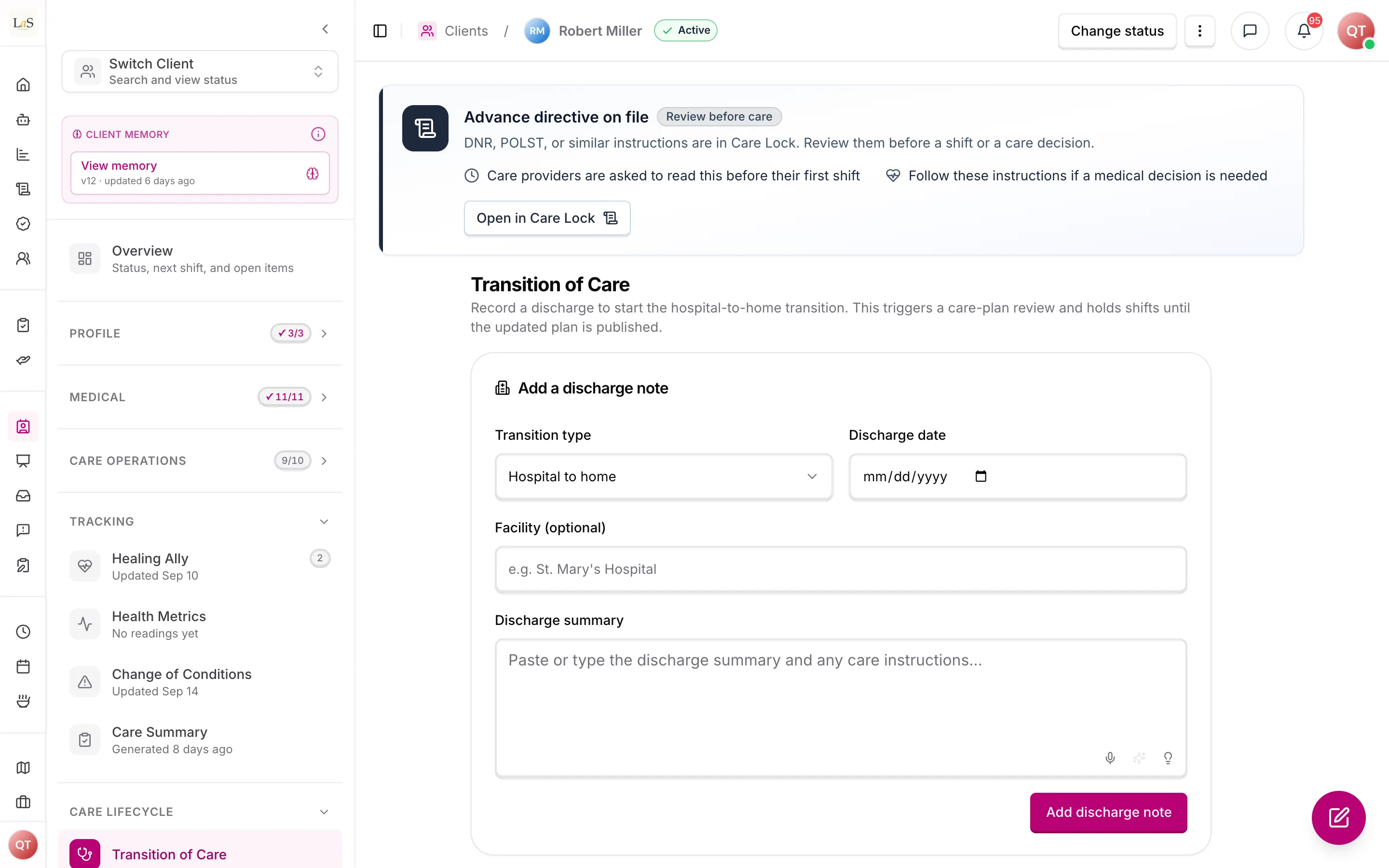
This is the hospitalization round-trip — the journey at the heart of the care lifecycle. A hospitalization is a real client state today: the client is moved to OnHold (see Clients, ), which hard-blocks shifts so no care runs on a stale plan while the client is away. When the client comes home, their discharge notes are added to the profile (see below). The discharge notes open a care-plan review (run as a reassessment): the care manager records the outcome and the client's care plan is updated to reflect the new condition before the first post-discharge shift can begin. The first shift is hard-blocked until the updated plan and its regenerated Care Task List are published (, ) — the gate releases when the daily instructions rebuilt from the new plan are republished, and is enforced both when the shift is created and again at clock-in, so a care provider never arrives for that first shift working from a pre-hospital plan. Only once the updated task list is published does the client move OnHold → Active and care resume.
Agency to agency
When a client moves from one agency to another, the responsible party authorizes the transfer. Once authorized, the new company gains access to the client and the previous company loses access immediately — there is no overlap window in which both agencies can see the client's data.
Home to facility
When a client moves into a residential facility, the client's care plan and care history are exported and provided to the receiving facility so the facility's staff start with the full picture.
Within-agency care-provider change
When the care provider assigned to a client's shifts changes inside the same agency, the incoming care provider is notified and prompted to review the client's profile and care plan before their first shift. The outgoing care provider's final shift notes are flagged for the incoming provider so the most recent observations are not missed. See Care Plans & Care Provider Tasks and Change of Conditions.
Discharge notes
Discharge notes capture a client's discharge from a hospital or facility and live in the client's profile. They can be added two ways: uploading a document directly into the profile, or writing a manual note by hand. On upload, the care manager is automatically notified, and the discharge notes trigger a care-plan review so the plan is brought up to date (this is the engine behind the hospital-to-home transition above). All discharge documents and notes are kept as a chronological document history in the profile and are shareable with authorized care providers and medical professionals. See Clients and Care Coordination & Provider Integration.
Rules
- TOC-1 — The platform must support four transition types: hospital to home, agency to agency, home to facility, and within-agency care-provider change. (⚠️ Partial — all four types are defined, but only hospital-to-home is wired to behavior)
- TOC-2 — On a hospital-to-home transition, the client's discharge notes must trigger a care-plan review. (✅ In code)
- TOC-3 — A hospital-to-home transition must present a transition checklist for the care manager to complete. (🚧 Spec only)
- TOC-4 — The client's care plan must be updated to reflect the new condition before the first post-discharge shift can begin. In practice the hard gate releases when the regenerated Care Task List built from the new plan is republished — the care provider works from the daily instructions, not the plan document directly, so the gate holds one step longer than the plan publish (which it necessarily post-dates). (✅ In code)
- TOC-5 — An agency-to-agency transfer must be authorized by the client's responsible party before it takes effect. (🚧 Spec only)
- TOC-6 — When an agency-to-agency transfer is authorized, the new company must gain access to the client and the previous company must lose access immediately, with no overlap window. (🚧 Spec only)
- TOC-7 — On a home-to-facility transition, the client's care plan and care history must be exported and provided to the receiving facility. (🚧 Spec only)
- TOC-8 — On a within-agency care-provider change, the incoming care provider must be notified and prompted to review the client's profile and care plan. (🚧 Spec only)
- TOC-9 — On a within-agency care-provider change, the outgoing care provider's final shift notes must be flagged for the incoming care provider. (🚧 Spec only)
- TOC-10 — Discharge notes must be addable both by uploading a document directly into the client's profile and by writing a manual note by hand. (✅ In code)
- TOC-11 — Uploading discharge notes must automatically notify the care manager. (✅ In code)
- TOC-12 — Discharge notes must integrate with the care plan: a discharge must trigger a care-plan review (see ). (✅ In code)
- TOC-13 — Discharge documents and notes must be stored as a chronological document history in the client's profile. (✅ In code)
- TOC-14 — Discharge notes must be shareable with authorized care providers and medical professionals, and never visible to anyone outside that authorization. (✅ In code)
- TOC-15 — The hospitalization round-trip. When a client returns from a hospitalization that involved a discharge, the client moves from OnHold back toward Active (the in-code client status machine, ) only after the hospital-to-home transition has run: the discharge note triggers a care-plan review (), which runs as a reassessment () and produces an updated care plan and regenerated instruction steps. The first post-discharge shift is hard-blocked until that updated plan and its regenerated Care Task List are published () — the gate releases on the task-list republish, and is held the same way OnHold holds shifts, not merely warned against. (✅ In code)
Who can do what
| Action | Roles |
|---|---|
| Start a transition of care | Owner, Admin, Care manager |
| Work the hospital-to-home transition checklist | Owner, Admin, Care manager |
| Update the care plan before the first post-discharge shift | Owner, Admin, Care manager |
| Authorize an agency-to-agency transfer | Representative (responsible party) |
| Export care plan and history to a receiving facility | Owner, Admin, Care manager |
| Assign or change the care provider on a client | Owner, Admin, Care manager |
| Review the profile and care plan after being assigned | Care provider (the incoming provider) |
| Upload a discharge document or write a manual discharge note | Owner, Admin, Care manager, Medical professional |
| View discharge notes / document history | Owner, Admin, Care manager; authorized Care providers and Medical professionals |
Decisions needed
- Who exactly may authorize an agency-to-agency transfer? The source names the responsible party (). Options: the responsible party only; allow any active representative on the client; require both the responsible party and the receiving agency to confirm.
- What does the previous agency keep after losing access? cuts access immediately, but agencies may have retention or audit obligations. Options: full hard cutoff; retain a read-only copy of records they authored for a retention window; retain nothing.
- What is on the hospital-to-home transition checklist? requires a checklist but does not define its items. Options: a fixed platform checklist; an agency-configurable checklist; an AI-suggested checklist drawn from the discharge notes.
- How are the care plan and history exported to a facility ()? Options: a generated PDF/report bundle; a structured data export; a secure shareable link the facility opens.
- (Resolved — in code) The first post-discharge shift is hard-blocked until the plan is updated (, ). The shift cannot start until the care manager records the reassessment outcome, publishes the updated plan, and republishes the regenerated Care Task List built from it — the gate releases on that task-list republish, so a care provider never works from stale pre-hospital instructions. This is the same hard-block the OnHold status applies to shifts, and it is now enforced on the transition flow — both when a shift is created and again at clock-in.
- Can a discharge note be edited or removed after upload (, )? Options: append-only with no edits; allow edits with a visible change history; allow the uploader a short correction window.
- (Resolved — own track, shared review) A discharge keeps its own transition track but converges on the common care-plan review. Transition of Care is its own flow (checklist, discharge notes, the hard gate), but the care-plan review it triggers is the same review action that change-of-condition and reassessment reach, per — so the three paths cannot diverge into separate review implementations. A change of condition that ends in a discharge hands off into this flow via .
How is this page?
Last updated on