Telehealth Services
Part of the Anaya Care Handbook — the source of truth for how the product must behave. When the product needs to change, change this document first, then make the system match it.
Implementation status — this module is specified but not yet built. Every rule below is 🚧 Spec only until the feature ships and this page is audited against the code. Legend: ✅ In code · ⚠️ Partial · 🚧 Spec only (not yet built).
What this covers
This page governs telehealth services: video consultations between a client and a medical professional, held inside the platform. A telehealth appointment is scheduled on the client's calendar, joined by everyone who needs to attend — the medical professional, a care manager, the care provider on shift, and the client's representative — and recorded as a transcript that captures the doctor's orders and care instructions. After the call, the transcript is turned into a session summary stored in the client's profile, and the orders can be carried into the client's care plan.
The video and transcription themselves come from a third-party telehealth provider the platform integrates with; that integration is itself Planned (see Integrations & API). This page describes how telehealth must behave once that provider is connected, not which provider is chosen.
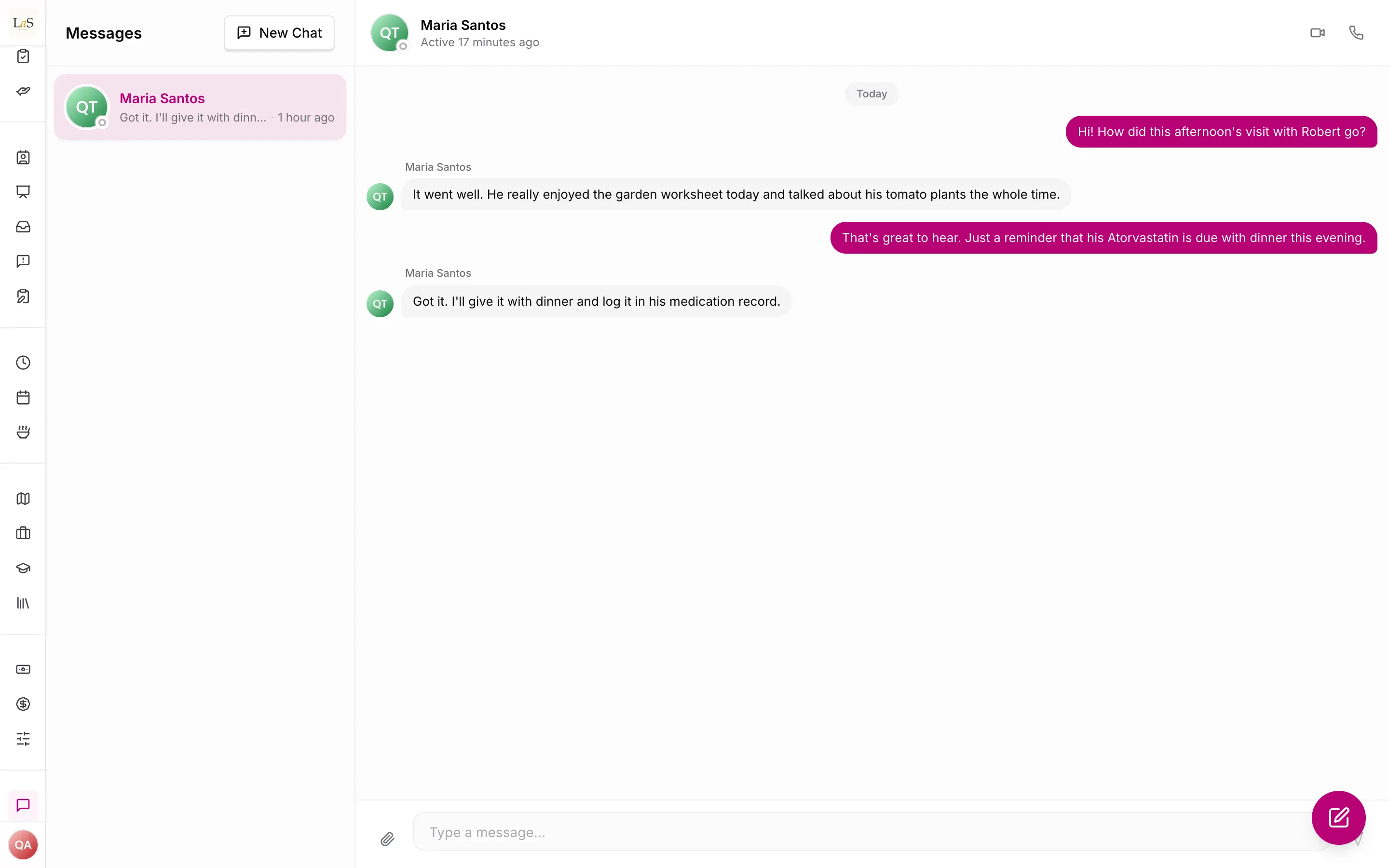
What exists today: any Care Connect chat can start an in-app video or voice call (top right). There is no telehealth appointment on the client's calendar, no transcript and no session summary.
Key terms
- Telehealth session — A scheduled video consultation between a client and a medical professional, held inside the platform.
- Medical professional — The licensed clinician (the client's doctor or a platform medical professional) who leads the consultation and issues orders and care instructions.
- Participant — Anyone admitted to a session: the medical professional, the client, a care manager, the care provider on shift, or the client's representative.
- Transcript — The text record of what was said during the session, produced automatically from the call so doctor's orders and care instructions are captured.
- Doctor's orders — Instructions the medical professional gives during the session — changes to reminders, tasks, readings, or follow-up — that may be carried into the care plan.
- Session summary — The condensed write-up of the session, derived from the transcript, that is filed in the client's profile.
- Telehealth provider — The third-party service supplying the video call and transcription, connected through an integration.
How it works
Scheduling a session
A care manager (or the medical professional) books a telehealth session against a specific client. The session is an appointment on the client's calendar with a date, time, and the medical professional leading it. Whoever is meant to attend — the care manager, the care provider on shift, and the client's representative — is added as a participant so the session shows on their schedules and they receive a reminder before it starts.
Joining and holding the session
At the appointed time, participants join the video call from the platform. The call runs on the connected telehealth provider. While the call is live, it is transcribed so that everything the medical professional says — orders, instructions, follow-up — is captured in text without anyone having to take notes by hand. The client, the medical professional, and the invited care team can all be present in the same call (multi-party access).
After the session
When the call ends, the transcript is turned into a session summary and stored in the client's profile alongside the client's other records. Any doctor's orders and care instructions captured in the transcript can then be used to update the client's care plan and tasks — a care manager reviews them before they take effect, so the care plan is never changed silently by the call. Telehealth sits within the platform's wider care coordination with outside providers.
Rules
- TELE-1 — A telehealth session must be a video consultation between a client and a medical professional, held inside the platform through the connected telehealth provider. (🚧 Spec only)
- TELE-2 — Every telehealth session belongs to exactly one agency and one client; users of one agency can never see another agency's sessions. (🚧 Spec only)
- TELE-3 — A telehealth session must be scheduled as an appointment on the client's calendar, with a date, time, and the medical professional leading it. (🚧 Spec only)
- TELE-4 — A session must support multi-party access: the medical professional, the client, a care manager, the care provider on shift, and the client's representative can all be added as participants and attend the same call. (🚧 Spec only)
- TELE-5 — Only invited participants may join a session; no one outside the participant list can enter the call. (🚧 Spec only)
- TELE-6 — Participants must be reminded of an upcoming session through the platform's standard notification channels (see Communication). (🚧 Spec only)
- TELE-7 — A live session must be transcribed so that the doctor's orders and care instructions spoken during the call are captured in text. (🚧 Spec only)
- TELE-8 — After the session, the transcript must be turned into a session summary and stored in the client's profile. (🚧 Spec only)
- TELE-9 — Doctor's orders and care instructions captured in the transcript may be used to update the client's care plan and tasks, but a care manager must review and confirm them before they take effect; the care plan must never change automatically from a call alone. (🚧 Spec only)
- TELE-10 — A telehealth session, its transcript, and its summary contain client health information and must be protected accordingly — never publicly accessible, and visible only to participants and to the management roles allowed to view the client's records. (🚧 Spec only)
- TELE-11 — Every viewing of a session, its transcript, or its summary must be recorded in the audit trail as health-information access; scheduling, joining, summarizing, and applying orders must each be recorded in the activity log. (🚧 Spec only)
- TELE-12 — The video call and transcription must be provided by the connected third-party telehealth provider; if that integration is unavailable, sessions cannot be held and the platform must say so rather than fail silently. (🚧 Spec only)
Who can do what
| Action | Roles |
|---|---|
| Schedule a telehealth session | Owner, Admin, Care manager, Medical professional |
| Lead the consultation and issue orders | Medical professional |
| Join a session as a participant | The session's invited participants (medical professional, client, care manager, care provider on shift, representative) |
| Review the summary and apply doctor's orders to the care plan | Owner, Admin, Care manager |
| View a session summary in the client profile | Owner, Admin, Care manager, Medical professional; the client's representative |
| Configure the telehealth provider integration | SuperAdmin, Owner, Admin |
Decisions needed
- Which telehealth provider does the platform integrate with, and is the call embedded or launched out? The provider is unchosen. Options: embed a provider's video inside the app; deep-link out to the provider and bring the transcript back; build calling natively (out of scope for Planned).
- Who owns and confirms the doctor's orders before they reach the care plan? requires a care manager to confirm, but the orders originate with the medical professional. Options: care manager confirms every order; medical professional's orders apply directly with a care manager review after the fact; the medical professional confirms their own orders and a care manager is only notified.
- Should the AI draft the session summary and a proposed set of care-plan changes from the transcript? Options: AI drafts the summary and suggests care-plan edits for a care manager to accept or reject; produce a plain transcript and summary only, with all care-plan edits entered by hand.
- What exactly may the representative see — the summary, the full transcript, or only that a session happened? lets participants view sessions, but representatives may not need the full clinical detail. Options: representatives see the summary only; the full transcript; or only the appointment record without the content.
- How long are recordings and transcripts retained, and may a session be recorded as video at all? Options: keep transcripts and summaries indefinitely with no video retention; retain video for a fixed window; never record video, transcript only. This must line up with Data Ownership & Retention.
- Does telehealth depend on the client's representative consenting to a session and to transcription? Options: require representative consent per session; capture a standing consent at onboarding; treat scheduling by a care manager as sufficient.
How is this page?
Last updated on