AI Chat Assistant
Part of the Anaya Care Handbook — the source of truth for how the product must behave. When the product needs to change, change this document first, then make the system match it.
What this covers
This page governs the : the general-purpose conversational helper available to every signed-in user, and the that screens every message before the AI sees it. The assistant is a general helper only — the AI that drafts care plans, tasks, meals, and summaries is governed by AI Features, and person-to-person chat by Communication.
Key terms
- AI chat assistant — a general-purpose conversational helper available to any signed-in user; it does not see client records or business data.
- Safety gate — a check that intercepts crisis or emergency messages in the AI chat and responds with crisis-line and emergency guidance instead of letting the AI answer.
- Subscriber-context-aware knowledge — the general care knowledge the assistant draws on; it starts from general elder-care knowledge and broadens as Anaya serves more care populations. It is not the agency's Knowledge Base and contains no client data.
- Keyword input — a single word or short phrase typed into the chat (for example, "falls" or "medication reminder") that the assistant treats as a valid starting point rather than rejecting.
How it works
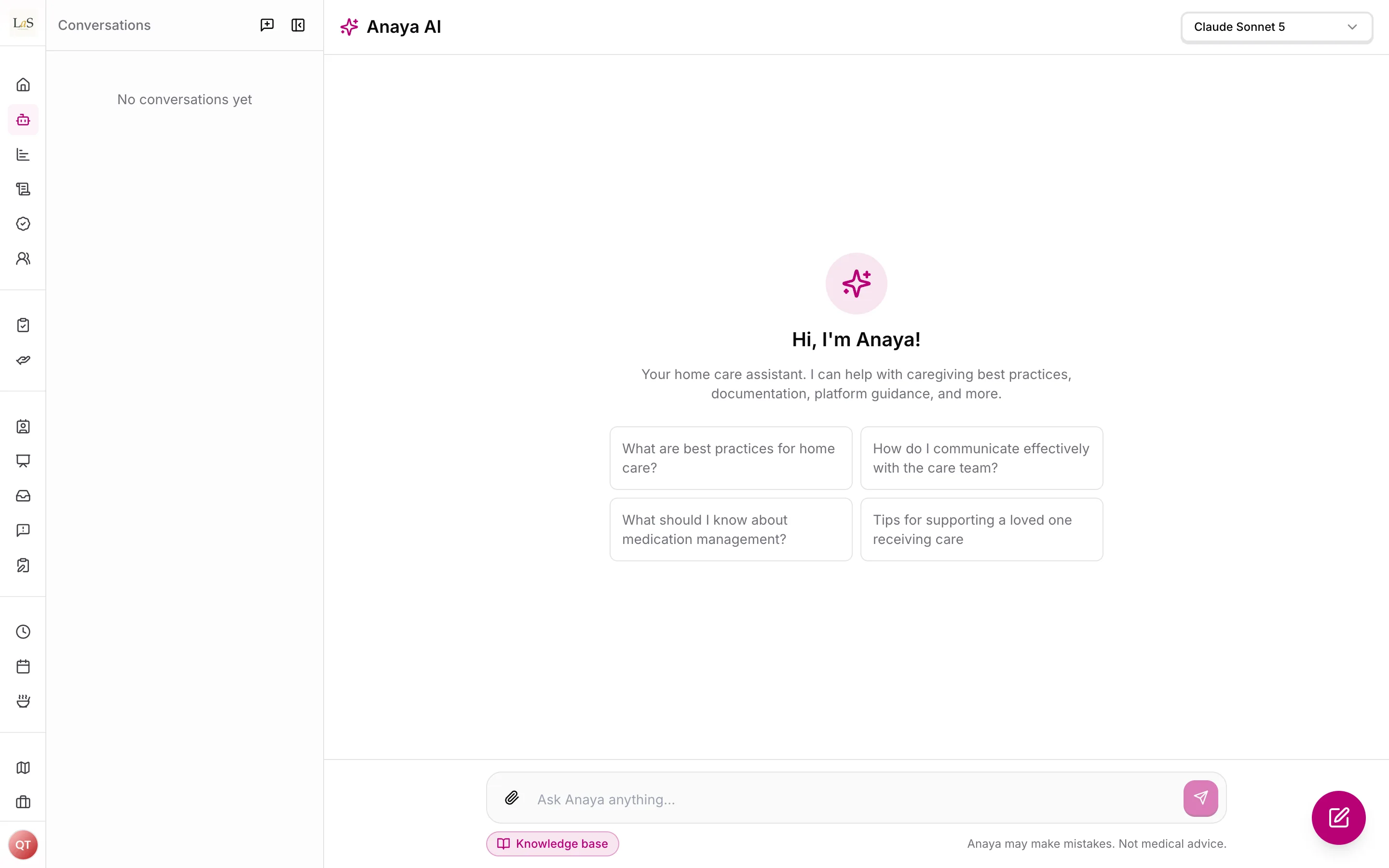
Every signed-in user — including independent care providers who do not belong to an agency — can chat with the AI assistant about caregiving topics, how to use the platform, and general questions. Conversations are private to the user who started them, are kept with their history, and are given an automatic title after the first exchange. The assistant stays within a caregiver's scope of practice and is a general helper only: it has no access to client records, the knowledge base, or any business data. It loads the shared plain-words section, so it answers in everyday words with no clinical labels (Anaya — the AI Persona ).
Before the AI ever sees a message, the safety gate checks it. A message indicating a mental-health crisis receives an immediate response pointing to the 988 crisis line; a message indicating a medical emergency receives an immediate response directing the user to call 911. Neither is answered by the AI.
What the assistant knows and how it answers
The assistant answers from general care knowledge, not from any one client's situation. That knowledge starts with general elder-care topics and is meant to broaden as Anaya serves more care populations. It stays methodology-agnostic — it shares general care knowledge for the agency's care population and does not promote any particular care methodology. It is a general helper, not a substitute for a care provider's or medical professional's own judgment, and it should never be treated as professional medical advice.
The assistant also accepts very short input. When a user types a single word or a short phrase, the assistant treats it as a valid starting point: it acknowledges what was typed first, then asks clarifying questions to narrow down what the user needs before giving a full answer.
Rules
- CHAT-1 — The AI chat assistant must be available to every signed-in user, including independent care providers without an agency.
- CHAT-2 — Every chat message must pass the safety gate before the AI sees it. Crisis messages always receive crisis-line (988) guidance and emergency messages always receive call-911 guidance; the AI must never be the one to handle them.
- CHAT-3 — The AI chat assistant must never access client records, the knowledge base, or any business data.
- CHAT-4 — A chat conversation is private to the user who created it; no other user can read it.
- CHAT-5 — The assistant must answer from general care knowledge that starts with general elder-care topics and broadens as Anaya serves more care populations; it must not draw on individual client profiles, care plans, or any personal health information. (🚧 Spec only)
- CHAT-6 — The assistant must stay methodology-agnostic: it shares general care knowledge for the agency's care population and must not promote any specific care methodology. (🚧 Spec only)
- CHAT-7 — When a user enters a single word or short phrase, the assistant must accept it as a valid starting point, acknowledge it first, and then ask clarifying questions before giving a full answer. (🚧 Spec only)
- CHAT-8 — The assistant must not present itself as a substitute for a care provider's or medical professional's own judgment or for professional medical advice. (🚧 Spec only)
Note: This page's rules were retired from the AI Features page: AI-10 – AI-13 → – . IDs are never reused.
Who can do what
| Action | Who is allowed |
|---|---|
| Use the AI chat assistant | Any signed-in user, including independent care providers |
Decisions needed
- Should users be able to rename their AI chat conversations? Today titles are automatic only. Options: allow renaming, or keep titles automatic.
How is this page?
Last updated on